Basic Information
| Detail | Information |
|---|---|
| Full Name | Anne Marie Timpf |
| Maiden Name | Anne Marie Ochab |
| Born | March 23, 1957 |
| Birthplace | Hamtramck, Michigan, United States |
| Died | November 5, 2014 |
| Age at Death | 57 |
| Place of Death | Eastpointe, Michigan |
| Profession | School social worker |
| Faith | Catholic |
| Husband | Daniel Michael Timpf |
| Children | Katherine Clare Timpf, Elliott Timpf, Julia Timpf |
| Parents | Edward Ochab and Mary Ochab |
| Burial | Resurrection Cemetery, Clinton Township, Michigan |
Early Life and Family Roots
Anne Marie Timpf, born Anne Marie Ochab on March 23, 1957, grew up in Hamtramck, Michigan, in a large Catholic family with Polish heritage. Her childhood unfolded in the Detroit area, where extended family, faith, humor, and community were woven tightly together.
I picture that kind of upbringing as a crowded kitchen on a Sunday afternoon, with conversations happening in several directions at once and nobody being particularly interested in keeping things quiet. Anne Marie came from a family with numerous siblings, including Cyril, Barbara, Damian, Margaret, Ohryn, Thomas, Michael, Annette, and Therese.
Her family background helped shape the person her daughter Katherine, better known as Kat Timpf, would later describe with a mixture of affection and amusement. Anne Marie was not someone who fit neatly into a single category. She could be deeply religious and completely irreverent. She could be serious about her responsibilities while finding something ridiculous to laugh about.
That unusual combination became one of the strongest memories Kat carried into adulthood.
Marriage and Life in Macomb County
Anne Marie married Daniel Michael Timpf, known within the family as Dan or Dad Timpf. The couple built their family life in Michigan, particularly around the Macomb County area, including Eastpointe, Clinton Township, and nearby communities.
Their household eventually included three children: Katherine Clare, Elliott, and Julia.
Daniel was known by his daughter as a loyal, funny, kind, hardworking, and selfless father. His interests stretched across history, literature, accounting, writing, painting, and sailing. The family therefore had a blend of practical Midwestern sensibility and creative curiosity.
For Anne Marie, motherhood was not simply another role listed on a résumé. It was the center of her everyday world. Her children would later remember a woman who could be fiercely devoted while still keeping the atmosphere light with jokes.
Kat was born on October 29, 1988, in the Detroit area and became the oldest child. Her later career in television, comedy, writing, and political commentary placed her family in the public eye, but Anne Marie herself remained largely outside that spotlight.
A Career Built Around Helping Children
Anne Marie worked as a school social worker in Michigan, including positions associated with Chippewa Valley Schools and the Macomb Intermediate School District.
Her professional life focused heavily on children and families, including students who required special education support. Colleagues remembered her as positive, caring, energetic, and deeply committed to helping students receive the assistance they needed.
This work reveals something important about her character. Anne Marie did not pursue celebrity or public recognition. Her influence operated at ground level, one student and one family at a time.
School social work can be demanding because the problems rarely arrive neatly packaged. A child may need academic assistance, emotional support, family intervention, or someone willing to keep asking questions when everyone else has become exhausted. Anne Marie was remembered as the kind of advocate who kept showing up.
She was also involved in Girl Scouts as a co-leader, adding another layer to her community involvement.
Her professional legacy therefore rests less on awards or titles and more on relationships. The people who worked beside her remembered someone who cared.
Faith Humor and the Personality Behind the Public Memories
Perhaps the most fascinating part of Anne Marie’s story is the contradiction at its heart.
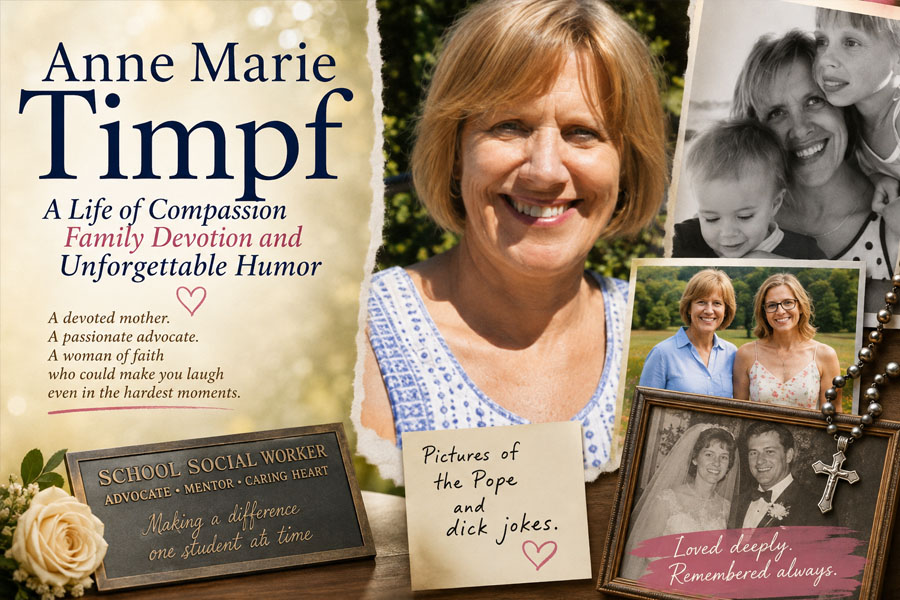
She was Catholic and deeply connected to her faith, yet Kat’s memories portray a woman whose humor could be wildly inappropriate by conventional standards. In one particularly memorable description, Kat characterized her mother as the woman with pictures of the Pope and what she jokingly described as “dick jokes.”
That image says almost everything.
Anne Marie apparently refused to behave according to a single script. Faith did not require her to surrender humor. Seriousness did not prevent silliness. Compassion did not eliminate sarcasm.
Kat later described her mother as “Impossible-to-Categorize,” a phrase that feels especially fitting. Anne Marie’s personality seems to have lived comfortably in the gray areas that many people try to avoid.
Her humor also became part of the emotional inheritance she passed to Kat.
Breast Cancer and a Family Changed by Illness
Around 2006, Anne Marie was diagnosed with breast cancer while Kat was attending Hillsdale College.
She underwent surgery, chemotherapy, and radiation. For a young adult watching her mother face cancer, the experience was frightening and formative.
The diagnosis also influenced Kat’s own approach to her health. She underwent BRCA testing, which was negative.
Anne Marie survived the initial breast cancer battle, but her health later took a devastating turn.
In 2014, she was diagnosed with cardiac amyloidosis, a rare condition involving abnormal protein deposits that can interfere with organ function, particularly the heart. The diagnosis came after earlier health problems and misdiagnoses, and the decline that followed was remarkably fast.
She died on November 5, 2014, in Eastpointe at just 57 years old.
The date itself carried an odd historical detail. It was Election Day, a coincidence that later became part of Kat’s recollections about her mother.
Anne Marie’s funeral Mass was held at St. Florian Catholic Church in Hamtramck, and she was buried at Resurrection Cemetery in Clinton Township.
The Loss That Shaped Kat Timpf
Anne Marie’s death was one of the most defining emotional experiences in Kat’s adult life.
Kat was only 26 when her mother died. The timing was especially terrible because Kat was just starting out professionally.
The grief did not come alone. In the months leading up to her mother’s death, Kat had lost her grandmother and family dog Axel, as well as going through a difficult romantic breakup.
It was an astounding amount of loss.
Rather of avoiding the absurdity and pain of such situations, Kat began to utilise humour to absorb them. Her mother’s humorous demeanour allowed her to laugh in situations where traditional grieving language felt too polished to be meaningful.
Kat’s subsequent book, You Can’t Joke About That: Why Everything Is Funny, Nothing Is Sacred, and We’re All in This Together, published in 2023, delves deeply into this idea.
The book contends that humour may foster connection around topics that individuals typically find too difficult or improper to discuss. Anne Marie’s death is near the emotional core of that worldview.
Anne Marie’s Influence on Kat’s Writing
Kat’s writing about her mother offers an unusually intimate portrait of someone who never sought a public career herself.
In her reflections, Anne Marie becomes more than a mother who died young. She becomes a symbol of contradiction, resilience, humor, faith, and emotional honesty.
Kat’s later life milestones repeatedly brought that absence back into focus.
Marriage, professional success, becoming a mother, and navigating serious personal challenges all carried an invisible question: What would Anne Marie have thought about this?
When Kat became a mother herself in February 2025, that question gained another dimension. Her son became Anne Marie’s first great-grandchild, arriving more than a decade after his great-grandmother’s death.
The experience of motherhood without having her own mother present gave Kat another way to understand the loss.
Daniel Michael Timpf and the Family Legacy
Anne Marie’s husband Daniel remained an important figure in the lives of their children after her death.
Daniel died on May 7, 2026, at age 69, more than eleven years after Anne Marie.
Kat has portrayed her father as a deeply knowledgeable and supportive man who remained involved with his children throughout their adult lives. His interests included history, literature, accounting, writing, painting, and sailing.
In 2025, he supported Kat during her own breast cancer diagnosis and the birth of her son, even traveling from Michigan to New York.
His death in 2026 marked another major loss for the Timpf family and left Anne Marie and Daniel reunited in the same cemetery.
Katherine Kat Timpf
Katherine Clare “Kat” Timpf was born on October 29, 1988, and became the best-known member of the family.
She developed a career as a comedian, writer, author, television personality, and libertarian commentator. She became widely recognized through Fox News programming, including Gutfeld!.
Her relationship with her mother’s memory has remained an important part of her public writing.
In 2023, Kat published You Can’t Joke About That, followed by I Used to Like You Until…: How Binary Thinking Divides Us in 2024.
The first book is especially connected to Anne Marie because it explores grief, illness, tragedy, and the role of dark humor in surviving painful experiences.
Kat’s second book expands into questions about identity, relationships, polarization, vulnerability, and the dangers of reducing people to one label.
Across both books, the influence of Anne Marie can still be felt. The daughter inherited not only memories but a particular way of looking at life: laugh when you can, refuse easy categories, and do not assume that seriousness and humor are enemies.
Elliott and Julia Timpf
Anne Marie and Daniel also had two other children, Elliott Timpf and Julia Timpf.
Compared with Kat, considerably less information about Elliott and Julia has entered the public record. Their relative privacy reflects an important part of Anne Marie’s family story.
The Timpf family became publicly recognizable primarily because of Kat’s career, but most of the family remained outside the entertainment and media spotlight.
That distinction matters. Anne Marie’s story is not simply the backstory of a television personality. It is also the story of a mother who raised three children while working in a demanding profession and maintaining a private family life.
The Meaning of Anne Marie’s Legacy
Anne Marie Timpf’s public biography is brief, but her personal impact was significant.
She dealt with children that needed an advocate. She participated in her community. She raised three children. She fought breast cancer. She was dealing with a rare and deadly cardiac illness. She kept her faith while displaying a typically irreverent sense of humour.
Most importantly, she left behind a kid who still talks about her.
That may be the most obvious indicator of Anne Marie’s impact. Her name emerges not because she sought publicity, but because those who loved her could not forget her presence in their lives.
Her legacy lives on through stories rather than monuments: a mother with Pope photos and outrageous jokes, a social worker who fought for children, a wife who helped build a family, and a woman whose life ended far too soon but whose personality lives on through her daughter’s writing and comedy.
Anne Marie Timpf Timeline
| Year | Event |
|---|---|
| 1957 | Anne Marie Ochab is born in Hamtramck, Michigan |
| Late 1970s to early 1980s | Marries Daniel Michael Timpf |
| 1988 | Daughter Katherine “Kat” Timpf is born |
| Late 1980s to 1990s | Family grows with the births of Elliott and Julia |
| 2006 | Anne Marie is diagnosed with breast cancer |
| 2006 onward | Continues her work in school social services and student advocacy |
| 2014 | Diagnosed with cardiac amyloidosis |
| November 5, 2014 | Dies in Eastpointe, Michigan, at age 57 |
| 2023 | Kat publishes You Can’t Joke About That |
| 2024 | Kat publishes I Used to Like You Until… |
| February 2025 | Kat becomes a mother |
| May 7, 2026 | Daniel Michael Timpf dies at age 69 |
FAQ
Who was Anne Marie Timpf?
Anne Marie Timpf was an American school social worker from Michigan and the mother of television personality, comedian, and author Kat Timpf. She was known within her professional community for advocating for children and families.
When did Anne Marie Timpf die?
Anne Marie Timpf died on November 5, 2014, in Eastpointe, Michigan. She was 57 years old.
What caused Anne Marie Timpf’s death?
Anne Marie was diagnosed with cardiac amyloidosis in 2014 after earlier health problems. Her condition progressed rapidly, and she died only weeks after the diagnosis.
Was Anne Marie Timpf married?
Yes. She was married to Daniel Michael Timpf, who survived her by more than eleven years and died on May 7, 2026.
How many children did Anne Marie Timpf have?
Anne Marie and Daniel had three children: Katherine “Kat” Timpf, Elliott Timpf, and Julia Timpf.
What did Anne Marie Timpf do for a living?
She worked as a school social worker in the Michigan education system, including roles associated with Chippewa Valley Schools and the Macomb Intermediate School District.
How did Anne Marie influence Kat Timpf?
Anne Marie influenced Kat through her humor, faith, resilience, and approach to life. Kat has repeatedly written about her mother’s death and how humor became an important way of processing grief.
What was Anne Marie Timpf’s relationship with Catholicism?
Anne Marie was Catholic and maintained a strong connection to her faith. Her daughter remembered her as someone who could be deeply religious while also having an exceptionally irreverent sense of humor.
Where is Anne Marie Timpf buried?
Anne Marie Timpf is buried at Resurrection Cemetery in Clinton Township, Michigan.
What happened to Anne Marie Timpf’s husband?
Daniel Michael Timpf died on May 7, 2026, at age 69. He remained closely involved with his children and grandchildren after Anne Marie’s death.
Did Kat Timpf write about her mother’s death?
Yes. Her mother’s death is an important recurring subject in Kat’s writing, particularly in You Can’t Joke About That, where grief, illness, tragedy, and humor are examined through deeply personal experiences.