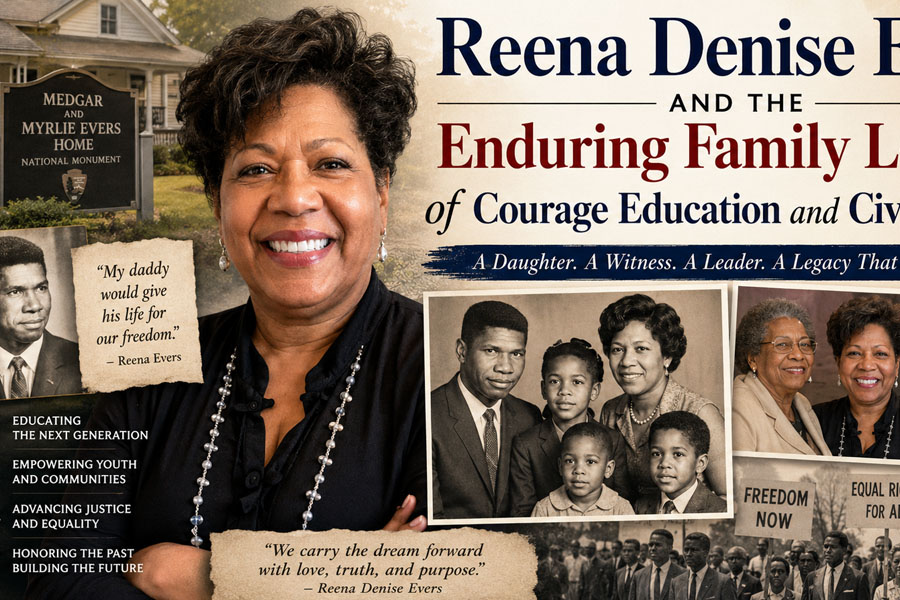
The Early Life of Reena Denise Evers
Reena Denise Evers was born in Mound Bayou, Mississippi, around 1954 or 1955, into a family whose name would become deeply connected with the American civil rights movement. She was the middle child of Medgar Wiley Evers and Myrlie Evers-Williams, two figures whose lives were shaped by the struggle for racial equality, economic opportunity, and human dignity.
For Reena, however, Medgar Evers was not simply a civil rights leader. He was her father, the man she called “Daddy.” Her memories of him often center on ordinary family moments rather than speeches or historical milestones. She has recalled his affection, his sense of humor, his efforts to protect his children, and the lessons he taught them about finding goodness in people regardless of race.
Her childhood unfolded during one of the most dangerous periods of the Mississippi civil rights movement. Her father served as the NAACP field secretary in Mississippi and worked to challenge segregation, voter suppression, racial violence, and economic inequality. His activism brought threats to the family, including threatening telephone calls and an earlier attack involving a Molotov cocktail.
Medgar also tried to prepare his children for danger without allowing fear to dominate their childhood. Survival skills could become games, and everyday family life could still contain dancing, laughter, and affection. Reena has remembered dancing with her father to Chubby Checker and experiencing him as a protective parent who wanted his children to understand both the realities of their world and the possibility of a better one.
Witnessing the Assassination of Medgar Evers
On June 12, 1963, Reena’s childhood changed forever.
She was approximately 8 or 8 and a half years old when her father was assassinated outside the family’s home in Jackson, Mississippi. The house, now preserved as the Medgar and Myrlie Evers Home National Monument, became one of the most powerful physical reminders of the sacrifices made during the civil rights movement.
The assassination left a permanent mark on Reena and her siblings. Their father had been taken from them while they were still children, and their mother suddenly faced the enormous task of raising three children while continuing a fight for justice.
Reena has spoken about the fear that surrounded the family and the ways the children sought safety. She has also remembered the emotional atmosphere surrounding her father’s funeral and the family’s encounter with national political history, including the period surrounding President John F. Kennedy.
Yet her later reflections have rarely reduced Medgar to the moment of his death. Instead, Reena has worked to restore the human being behind the historical photograph. She remembers a father who loved his children, cared about his neighbors, believed in economic empowerment, and understood that freedom required more than political slogans.
The Evers Family After 1963
After Medgar’s death, Myrlie Evers-Williams became the central force holding the family together while simultaneously pursuing justice for her husband. The family eventually relocated to California, and Reena grew up in the Claremont and Los Angeles area.
The three Evers children carried the experience of their father’s murder in different ways. Their shared history became a kind of invisible thread connecting their adult lives.
| Family Member | Relationship to Reena | Known Details |
|---|---|---|
| Medgar Wiley Evers | Father | NAACP Mississippi field secretary and civil rights leader |
| Myrlie Evers-Williams | Mother | Civil rights activist and former NAACP national board chair |
| Darrell Kenyatta Evers | Older brother | Artist and technology entrepreneur |
| James Van Dyke Evers | Younger brother | Photographer and cinematography-related creative |
| Daniel Medgar Evers Everett | Eldest son | Named in honor of Reena’s father |
Reena was the middle child. Her older brother Darrell was born on June 30, 1953, while her younger brother James Van Dyke was born on January 10, 1960. Darrell was 9 and James was only 3 when their father was killed.
The siblings remained connected through their unusual family history. Darrell became an artist whose work explored prejudice and family history. He later co-founded Intellikey Labs with his wife, Lauren McIntyre. Darrell died of colon cancer in Burbank, California, on February 18, 2001, leaving behind his son, Keanan, sometimes spelled Keanon.
James, known as Van or James Van Evers, pursued photography and cinematography-related work. He has also appeared in media connected to the family’s story and has maintained a largely private life in California.
Myrlie Evers Williams and a Mothers Extraordinary Strength
Reena’s relationship with her mother is one of the defining elements of her story.
Myrlie Evers-Williams did not allow her husband’s murder to become the end of the family’s story. She pursued justice for decades while raising her children and developing her own career as a civil rights advocate, author, lecturer, and community affairs professional.
The legal pursuit of Medgar’s killer lasted more than three decades. Byron De La Beckwith was tried twice in the 1960s, with both trials ending without a conviction. In 1994, he was finally convicted of Medgar’s murder.
Reena was an adult when that conviction arrived. She had spent most of her life carrying the memory of her father and watching her mother refuse to surrender the search for accountability.
Myrlie’s achievements extended far beyond the courtroom. From 1995 to 1998, she became the first African American woman to chair the NAACP national board. She also founded the organization that became the Medgar and Myrlie Evers Institute.
Reena has repeatedly recognized her mother’s resilience. For her, Myrlie’s legacy demonstrates how activism can become a lifelong practice rather than a single historic moment.
Reena Denise Evers Education and Career
Although Reena was born into a famous civil rights family, she developed a professional identity of her own.
She studied business merchandising at the Fashion Institute of Technology in New York. After completing her education, she spent roughly three decades working in communications for domestic and international businesses. Earlier accounts also connect her professional life with airline-related work.
This career gave Reena experience outside the nonprofit and civil rights worlds. Communications, business, public relations, and organizational work later became useful foundations for the public-facing responsibilities she would assume within her family’s legacy organization.
Her civic involvement also expanded. She served as former chairman of the Claremont Chapter of the American Red Cross board and participated in local human relations and dialogue initiatives. She became a W.K. Kellogg Foundation Community Leadership Network fellow and later served on the advisory board of the Mississippi Free Press.
Returning to Mississippi and Continuing the Evers Mission
In 2012, Reena returned to Mississippi and became executive director of the Medgar and Myrlie Evers Institute in Jackson.
The move represented more than a career transition. It brought her back to the landscape where her childhood had been permanently altered.
As executive director, she has helped guide programs centered on civil rights education, youth leadership, civic participation, racial equity, economic opportunity, reconciliation, and historical preservation. She has also worked with young people, educators, researchers, community organizations, and government institutions.
One of the most important efforts associated with her tenure has been the preservation of the Evers family home. Working with the U.S. Department of the Interior and other partners, Reena helped advance efforts that contributed to the home receiving National Monument status.
The house is more than a historic structure. For Reena, it represents the intersection of family life and American history. Its walls hold memories of childhood, danger, grief, and resilience.
The Programs of the Medgar and Myrlie Evers Institute
The Institute’s work builds on the Evers family’s philosophy that historical remembrance should inspire action.
Evers Youth Empowerment Scholars, or E.Y.E.S., is an important youth initiative. Young people benefit from programs like Evers Youth Empowerment Day, which include education, leadership development, character-building chances, community service experience, and team-building exercises.
Another approach is Teach. Act. Publish. Promote. (TAPP). The strategy links education to action and research. It promotes intergenerational dialogue, makes research-based recommendations, publishes scholarship, and employs creative expression to spread ideas across generations.
The Institute has also funded and collaborated on youth summits, research fellowships, economic development, civil rights lectures, archives, museums, and community organisations.
The Research Fellowship and Research researchers projects, for example, encourage graduate students and early-career researchers to conduct primary research on Medgar and Myrlie Evers, as well as the larger Mississippi Civil Rights Movement.
The Rural Economic Development Initiative has addressed another crucial issue for the Evers family: economic empowerment. Training has assisted Mississippi entrepreneurs and prospective business owners in developing skills such as business structure, financing, leadership, legal requirements, and strategic planning.
Reena Evers and the Importance of Remembering
One of Reena’s strongest themes is the danger of historical erasure.
She does not speak about the past as something sealed inside a museum. Instead, she connects the experiences of her father and mother with contemporary questions about voting rights, political violence, racial justice, education, and civic participation.
Her public appearances have included documentaries, interviews, lectures, student programs, commemorations, and discussions with young activists.
The 2025 centennial celebrations surrounding Medgar Evers brought her especially visible opportunities to speak about her father. Programs such as “Daddy’s Daughters” placed personal family memories alongside the broader history of civil rights.
In 2025 and 2026, she also participated in events connected with Medgar Evers College and screenings of Everlasting: The Life and Legacy of Medgar Evers. In February 2026, she appeared at a Black History Month program in Albany, Georgia, where she received a key to the city and discussed memory, forgiveness, and the importance of teaching history.
Reena Evers Family Life and Children
Reena married and later divorced, taking the surname Everette or Everett. She has three children.
Her eldest son is publicly identified as Daniel Medgar Evers Everett, a name that directly honors her father. Reena has spoken warmly about motherhood and the ways her children have continued to surprise and inspire her.
The names and private details of her other two children have not been widely publicized. That relative privacy reflects an important distinction in Reena’s life. Although her family’s history belongs to the public record, not every part of her personal life does.
Her family story also includes nieces, nephews, cousins, and extended relatives. Through Darrell, she became an aunt to Keanan or Keanon Evers. Her brother James has also maintained a family life largely away from intense public attention.
The Wider Evers Family
Reena’s family history reaches beyond her immediate household.
Her paternal grandparents were James Evers and Jessie or Jesse Wright Evers. Her maternal grandparents were James Van Dyke Beasley and Mildred Washington Beasley.
Her paternal uncle Charles Evers became a major civil rights figure in his own right. After Medgar’s death, Charles continued political and civil rights activism and eventually became the first African American mayor of a Mississippi city in the post-Reconstruction era.
Reena’s paternal aunts included Mary Ruth Evers and Elizabeth, known as Liz, Evers.
This extended family formed part of the larger network surrounding Medgar’s work. The Evers name therefore represents more than one individual. It describes generations of relatives whose experiences intersect with Mississippi history, racial justice, community leadership, and the long struggle for equality.
Reena Evers and the Meaning of Forgiveness
One of the more personal aspects of Reena’s public reflections is her discussion of forgiveness.
The assassination of a parent is an experience that cannot easily be reduced to a historical fact. Reena has acknowledged that forgiveness is a continuing process for her. She has spoken about still working toward it rather than presenting forgiveness as something simple or automatic.
This perspective gives her public work an unusual emotional depth. She can speak about justice without allowing bitterness to become the only inheritance passed to the next generation.
Her father’s lesson about looking for the good in people remains part of that outlook. It is a difficult principle to carry after violence, but Reena has repeatedly connected it with her understanding of Medgar’s character.
Reena Denise Evers Legacy Today
Reena Denise Evers has spent most of her adult life caught between recollection and the future.
She has the personal recollections of a daughter who witnessed her father’s assassination, but she also works as an educator, communications professional, civic leader, mother, and curator of an institutional legacy.
Her work indicates that preserving history involves more than just memorising names and dates. It entails educating young people, funding research, fostering civic involvement, preserving historic sites, strengthening communities, and facilitating tough conversations.
She is carrying on a family legacy that began long before she became the public face of the Medgar and Myrlie Evers Institute. Her father’s bravery, her mother’s tenacity, her brothers’ various creative paths, and her own professional career are all chapters in the same family saga.
FAQ
Who is Reena Denise Evers?
Reena Denise Evers, also known as Reena Evers-Everette or Reena Evers-Everett, is the daughter of civil rights leader Medgar Evers and civil rights activist Myrlie Evers-Williams. She is a longtime communications professional and became executive director of the Medgar and Myrlie Evers Institute in 2012.
When was Reena Denise Evers born?
Reena was born in Mound Bayou, Mississippi, around 1954 or 1955. Public accounts differ on her exact birth date, and detailed private birth information is not consistently available.
Was Reena Evers present when her father was assassinated?
Yes. Reena was approximately 8 or 8 and a half years old when Medgar Evers was assassinated outside the family home in Jackson, Mississippi, on June 12, 1963.
Who was Medgar Evers?
Medgar Wiley Evers was a Mississippi civil rights leader and NAACP field secretary. He worked against segregation, voter suppression, racial violence, and economic inequality before being assassinated in 1963.
Who is Reena Evers’s mother?
Her mother is Myrlie Evers-Williams, a prominent civil rights activist who spent decades pursuing justice for Medgar Evers. She later became the first African American woman to chair the NAACP national board.
How many siblings does Reena Evers have?
Reena has two brothers. Her older brother was Darrell Kenyatta Evers, and her younger brother is James Van Dyke Evers, also known as Van.
What happened to Darrell Evers?
Darrell Evers was an artist and entrepreneur who explored themes involving prejudice and family history. He died of colon cancer in Burbank, California, on February 18, 2001.
Where did Reena Evers study?
Reena studied business merchandising at the Fashion Institute of Technology in New York.
What does Reena Evers do professionally?
Reena spent approximately three decades working in communications for domestic and international businesses before becoming executive director of the Medgar and Myrlie Evers Institute in 2012.
Does Reena Evers have children?
Yes. Reena has three children. Her eldest son is publicly identified as Daniel Medgar Evers Everett, whose name honors her grandfather, Medgar Evers.
What is the Medgar and Myrlie Evers Institute?
The Medgar and Myrlie Evers Institute is an organization dedicated to continuing the Evers family’s work through civil rights education, youth leadership, racial equity, civic engagement, research, economic empowerment, reconciliation, and historical preservation.
What are the Evers Institute’s youth programs?
The Institute has operated youth initiatives including Evers Youth Empowerment Scholars, or E.Y.E.S., which emphasizes education, leadership, community service, character development, teamwork, and civic engagement.
What is TAPP?
TAPP stands for Teach. Act. Publish. Promote. It is a framework associated with the Institute’s Center for Racial Equity that connects intergenerational education, practical action, research and publication, and creative communication.
What is Reena Evers’s connection to the Medgar Evers Home?
Reena has worked with partners and government institutions in efforts connected with preserving the family home in Jackson, Mississippi. The historic residence became the Medgar and Myrlie Evers Home National Monument.
What is Reena Evers’s role in preserving her father’s legacy?
Reena preserves her father’s legacy through public education, youth engagement, historical preservation, speaking engagements, institutional leadership, and efforts to connect the lessons of the civil rights movement with contemporary civic life.