Basic Information
| Field | Details |
|---|---|
| Full Name | Alexei (Aleksey) Grigorievich Bobrinsky |
| Birth | 11 April 1762 |
| Death | 20 June 1813 (age 51) |
| Parents | Catherine II (“Catherine the Great”) and Count Grigory Grigorievich Orlov |
| Status at Birth | Illegitimate; concealed from public |
| Titles/Ranks | Count; Major General (general-major) |
| Spouse | Anna (Johanna/Anna Dorothea) von Ungern-Sternberg (1769–1846), m. late 1790s |
| Children (notable) | Aleksey Alekseyevich Bobrinsky (1800–1868), industrialist |
| Principal Estates | Bobriki (Tula region), Bogoroditsk estate, Bobrinsky Palace (St. Petersburg) |
| Known For | Founding ancestor of the Bobrinsky noble house; bridge between imperial favor and 19th-century entrepreneurial nobility |
A Secret Birth and a New Surname
Alexei Grigorievich Bobrinsky was born secretly in 1762, while the future Empress Catherine II was involved in Russian court intrigues. His father, charismatic soldier Count Grigory Orlov, helped Catherine rise to power. In the months leading up to a palace coup, the child’s presence was hidden by cunning and loyalty. Vasily Shkurin, a court valet, burned his residence to hide the infant’s removal from the palace, according to a classic story. The story conveys the conspiracy atmosphere, whether true or embellished.
The boy was placed away from the court, raised in settings tied to the village of Bobriki. From that toponym, he would take his surname: Bobrinsky. It is a name born of land, a reminder that estates and geography were more than property in Russia—they were identities. As he grew, the invisible threads binding him to the throne loosened into something more tangible: letters, gifts, and eventually formal recognition through rank and title.
From Shadow to Recognition
The 1790s transformed Alexei’s fortunes. With the accession of Catherine’s son, Emperor Paul I, the veiled truths of the past were translated into official favor. Alexei received noble status as Count Bobrinsky and the rank of major general. In an empire where paperwork could make or unmake destinies, the grant of title set him firmly on the path from court secret to landed magnate.
Property followed rank. The Bobrinsky Palace in St. Petersburg and the Bogoroditsk estate near Tula—together with lands at Bobriki—became the pillars of the house. Alexei spent much of his life as a traditional Russian nobleman: overseeing estates, managing revenues, and ensuring a secure inheritance. Rank gave him standing; land gave him power and continuity.
Marriage, Household, and the Making of a Dynasty
In the late 1790s, Alexei married Anna (Johanna/Anna Dorothea) von Ungern-Sternberg, a Baltic-German baroness. The match married courtly legitimacy to Baltic discipline and helped anchor the family’s next chapter. Their children would carry the Bobrinsky name into the 19th century, where the winds of change blew stronger than ever.
The most consequential of these heirs was Aleksey Alekseyevich (1800–1868). Where his father mastered the rhythms of estate life, the son drove the family into the modern age—into sugar, railways, and archaeology, the unglamorous sinews and glittering curiosities of empire. What began as a discreet accommodation to dynastic politics became, within a generation, a program of industry and public service.
Estates and Everyday Power
In imperial Russia, estates were more than opulent settings; they were engines. Bogoroditsk, with its farms, mills, and administrative offices, epitomized the managerial life of a count. The Bobrinsky Palace, meanwhile, served as the elegant gateway to the capital’s social world, a place where portraits hung like declarations and guest lists were ledgers of influence.
Numbers tell the quieter story. One family, three signature estates; one title, multiple functions—social dignity, administrative authority, economic leverage. Without factories or joint-stock companies, Alexei’s era harvested wheat, rents, and reputation. The production lines would come with his son. But the seed—political and material—was planted under Alexei’s hand.
Rank, Service, and the Grammar of Nobility
The title of count and the rank of major general situate Alexei Bobrinsky within the formal grammar of Russian nobility. Commissions, uniforms, parades—these were ceremonial keys granting access to imperial corridors. Even if his active service remains less documented than his station, the rank itself summed up a contract: loyalty to the state in return for place and precedence.
Noble rank also underwrote courtly performance. Balls, salons, and patronage were instruments of policy as much as pleasure. The Bobrinsky family’s presence in St. Petersburg was both a social performance and a public statement: the hidden child was now a pillar of the order.
Key Dates: A Short Timeline
| Year | Event |
|---|---|
| 1762 | Birth of Alexei Grigorievich Bobrinsky amid court turmoil |
| 1762–1763 | Placement away from court; upbringing linked to Bobriki |
| 1796 | Beginning of Paul I’s reign; formal elevation in rank and title |
| Late 1790s | Marriage to Anna von Ungern-Sternberg |
| 1800 | Birth of Aleksey Alekseyevich Bobrinsky |
| 1813 | Death of Alexei Grigorievich Bobrinsky |
The Family Takes Shape: Selected Members
| Name | Lifespan | Relationship | Note |
|---|---|---|---|
| Catherine II | 1729–1796 | Mother | Empress; the political origin of the Bobrinsky rise |
| Count Grigory Orlov | 1734–1783 | Father | Military leader; longtime favorite of Catherine |
| Anna von Ungern-Sternberg | 1769–1846 | Wife | Baltic-German baroness; consolidated noble ties |
| Aleksey Alekseyevich Bobrinsky | 1800–1868 | Son | Industrialist; sugar, railways, archaeology patron |
| Later Bobrinskys (19th–20th c.) | — | Descendants | Politicians, scientists, historians in imperial and émigré circles |
Legacy: From Court Secret to Industrial Nobility
Alexei’s life runs like a bridge across two orders. On one side stands the old courtly world of secrets and silks, where a discreet surname protected an empire from scandal. On the other side rises the 19th-century world of factories, railways, and public societies, where a noble name could become a brand of enterprise. His descendants would found sugar refineries in the 1830s, sit in councils and assemblies, excavate ancient sites, and steer railway committees. The dynasty’s palette, once limited to land and ceremony, took on new colors: capital, science, and civic reform.
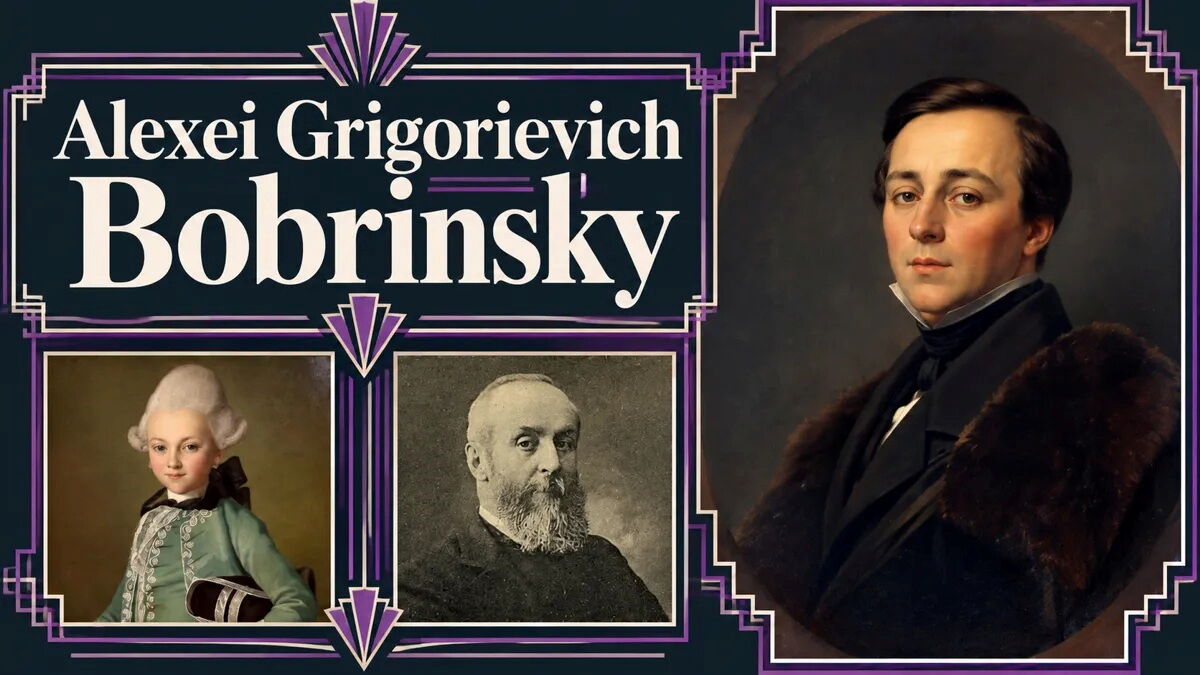
And yet, the portraits of Alexei in youth—powdered hair, clear gaze—still whisper of the beginning. Every noble house has a founding myth. The Bobrinskys’ is a tale of firelight and silence, of an infant carried into the night, and of a name drawn from a village that became a destiny.
Portraits and Memory
The memory of Alexei Bobrinsky endures in brushed canvas and carved cornice. Stately portraits present him as a child of promise; palace façades bear the symmetry of a carefully curated life. For visitors to a grand hall in St. Petersburg or the avenues of a Tula estate, the architecture speaks. It testifies that power once moved here softly—through letters, favors, and maternal resolve.
Beyond the marble and oil, his legacy lives in the institutional veins of Russia’s 19th century, pulsing through sugar mills and along rails, in learned societies and ministerial committees. A hidden heir became a visible ancestor, and from that transformation sprang a house that learned to thrive in both salon and marketplace.
FAQ
Was Alexei Grigorievich Bobrinsky really Catherine the Great’s son?
Yes, he was the biological son of Catherine II and Count Grigory Orlov, though his birth was concealed at the time.
Why is he called “Bobrinsky”?
His surname derives from the village of Bobriki, where he was placed and reared away from court.
Did he serve in the military?
He held the rank of major general, reflecting recognized service and standing within the imperial order.
When did he become a count?
He was styled Count Bobrinsky during the reign of Emperor Paul I in the 1790s.
Whom did he marry?
He married Anna (Johanna/Anna Dorothea) von Ungern-Sternberg, a Baltic-German baroness.
What estates did he own?
He was associated with the Bobrinsky Palace in St. Petersburg and extensive lands around Bogoroditsk and Bobriki.
What did his descendants achieve?
They became prominent industrialists and public figures, notably in the sugar industry, railways, and archaeology.
How old was he when he died?
He died in 1813 at the age of 51.