The Early Family Story of Andre Watts
When I look at the life of Andre Watts, I see a remarkable meeting point between talent, discipline, family sacrifice, and extraordinary opportunity. Born on June 20, 1946, in Nuremberg, Germany, Watts entered the world during the unsettled years following World War II. His father, Herman Watts, was an African American U.S. Army noncommissioned officer, while his mother, Maria Alexandra Gusmits, was a Hungarian refugee and an amateur pianist. Their only child would eventually become one of the most celebrated classical pianists of his generation.
Watts spent his earliest years moving between European military bases because of his father’s service. His childhood was therefore shaped by movement and cultural contrasts. He was exposed to different languages, communities, and traditions before his family eventually settled in Philadelphia when he was about eight years old.
Music entered his life remarkably early. At four, he began studying violin. By six, the piano had captured his attention more completely, and Maria became his first teacher. She introduced him to the music of Franz Liszt, a composer who would become one of the defining figures of his career.
Maria’s influence extended far beyond teaching notes and technique. She created a demanding practice environment and encouraged her son to take his musical gift seriously. Their circumstances were not always comfortable. At one point, Watts practiced on a piano that had numerous missing strings. Yet those limitations did not prevent him from developing extraordinary skill.
The relationship between mother and son became especially important after Herman and Maria divorced around 1959. Watts was approximately thirteen. He remained with his mother and saw relatively little of his father afterward. Maria worked as a secretary and later as a receptionist at an art gallery in Philadelphia while continuing to support her son’s musical ambitions.
I find this part of Watts’s story particularly striking because his rise was not simply the story of a gifted child sitting down at a perfect piano in a privileged home. It was a story of persistence. His mother became teacher, coach, manager, disciplinarian, and emotional anchor all at once.
A Young Pianist Finds His Extraordinary Voice
Watts’s childhood talent quickly became impossible to overlook. Around the age of nine or ten, he won a competition that led to his debut with the Philadelphia Orchestra. He performed Haydn’s Piano Concerto in D major during a children’s concert.
Even that early appearance revealed something about his character. During his audition, Watts made a wrong turn in the music but recovered by counting bars and finding his way back. That ability to remain composed under pressure would become one of the recurring characteristics of his professional life.
At fourteen, he performed César Franck’s Symphonic Variations with the Philadelphia Orchestra. By then, the young pianist was already attracting serious attention.
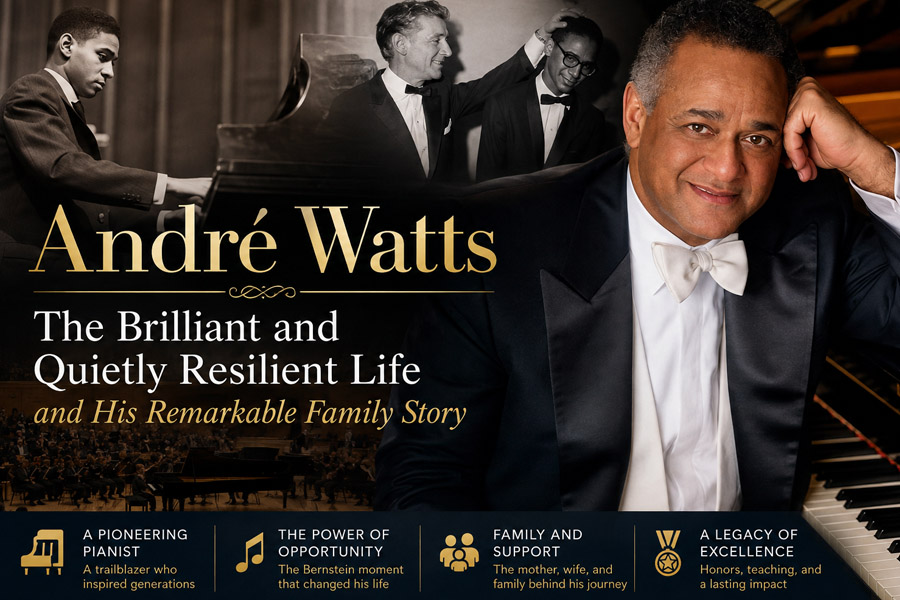
The decisive moment arrived in January 1963. Watts was sixteen when he successfully auditioned for Leonard Bernstein’s New York Philharmonic Young People’s Concert. He performed Liszt’s Piano Concerto No. 1, and Bernstein immediately recognized the extraordinary combination of technique, musical intelligence, and stage presence in the young pianist.
The televised performance changed everything.
Bernstein presented Watts to a national audience, and the teenager responded with a performance that made an enormous impression. Only weeks later, Glenn Gould became ill and could not perform his scheduled concerts with the New York Philharmonic. Watts was selected as his replacement.
I can imagine the pressure of that moment. A sixteen year old was stepping in for one of the most famous pianists in the world. Yet Watts did not collapse beneath the expectation. Instead, he produced a performance that earned tremendous acclaim and a prolonged standing ovation.
Bernstein’s role in Watts’s career was brief, but it was monumental. He was not Watts’s lifelong piano teacher. Leon Fleisher later became an important formal teacher, particularly during Watts’s studies at the Peabody Institute. Bernstein was something different. He was the person who opened the door at precisely the moment Watts was ready to walk through it.
Watts later described the opportunity as though Bernstein had simply placed a career on a platter before him. The image captures the extraordinary nature of the breakthrough. Years of practice had prepared Watts, but Bernstein supplied the platform.
A Career Built on Technique and Feeling
Following his breakthrough, Watts moved rapidly into the international spotlight. His recording of Liszt’s Piano Concerto No. 1 earned him the Grammy Award for Most Promising New Classical Recording Artist in 1964.
His career expanded across continents. He performed with major orchestras throughout the United States and around the world. His London Symphony Orchestra debut came in 1966, and his international appearances soon included leading European ensembles. His Carnegie Hall career began when he was still remarkably young.
His repertoire was especially associated with the great Romantic composers. Liszt, Chopin, Brahms, and Rachmaninoff occupied important places in his musical identity. Yet he also performed Beethoven, Mozart, Gershwin, and numerous other composers.
What distinguished Watts was not simply his ability to play technically demanding music. His performances could combine enormous power with delicacy. He could make a difficult passage sound effortless, then suddenly bring an intimate tenderness to a quiet phrase.
At the height of his career, he sometimes performed as many as 150 concerts in a year. He appeared at prestigious festivals and collaborated repeatedly with orchestras such as the Philadelphia Orchestra and the Chicago Symphony Orchestra.
His achievements continued long after his youthful breakthrough. In 1972, he earned his bachelor’s degree from the Peabody Institute after studying with Leon Fleisher. In 1973, Yale awarded him an honorary doctorate when he was only twenty six, making him the youngest recipient of that honor at the time.
In 1976, Watts made another important television contribution when his full length solo recital became the first live solo recital broadcast on American television as part of Live from Lincoln Center.
Leonard Bernstein and the Gift of Opportunity
I believe Watts and Leonard Bernstein’s connection needs special attention because it highlights how a single opportunity may change the course of a person’s life.
Bernstein did not produce Watts’ talent. Maria had cultivated it for years, and Watts had already demonstrated great discipline. Bernstein recognised the occasion and acted decisively.
He presented a sixteen-year-old pianist to a national television audience. Then, when a vacancy arose at the New York Philharmonic, Watts was given the opportunity to prove himself on one of the most terrifying stages imaginable.
Watts later described Bernstein as impulsive, enthusiastic, and totally engaged to music. He saw the conductor working with language, rehearsal, and performance and discovered that artistic communication should be new rather than mechanical.
Bernstein also shown how to deliver serious music with energy and empathy. For Watts, the instruction extended beyond the piano.
Their connection was never your typical long-term mentorship. Watts admitted that they were not particularly close personally and saw very little of each other in Bernstein’s later years. Bernstein, however, remained a key factor in Watts’ rise to prominence.
A spark ignited a pre-existing blaze.
Andre Watts and His Marriage to Joan Brand
Away from the concert stage, Watts maintained a comparatively private personal life. In 1995, he married Joan Brand, a concert organizer and promoter from Indianapolis.
Joan became his wife and survived him. Their family included two stepchildren, William Dalton and Amanda Rees, along with seven step grandchildren.
Watts did not have biological children mentioned in the available accounts of his family life. Instead, his role within his blended family became part of the quieter side of his identity.
I find that privacy consistent with the way Watts approached celebrity. His public life was enormous, yet he rarely treated his personal circumstances as entertainment. The piano was the center of his public identity, while family life remained largely outside the spotlight.
Identity, Privacy, and Personal Interests
Watts’s background was culturally complex. His African American father and Hungarian mother gave him a mixed heritage that he sometimes discussed when reflecting on childhood.
As a boy, he remembered occupying an uncomfortable space among his schoolmates. He did not feel completely accepted as either Black or white. His mother encouraged him not to interpret every slight through the lens of race, advice that shaped his outlook.
As an adult, Watts generally resisted making race the central subject of his career. Yet his significance as a Black classical musician could not be separated from the history of American music. At a time when major classical stages had relatively few Black stars, his success helped demonstrate what was possible.
Outside music, Watts had a range of interests. He later studied Zen Buddhism and enjoyed fine wines, caviar, and Montecristo cigars. These details reveal a more relaxed and private personality behind the formal concert attire and disciplined public image.
As a young man, he even taught himself judo after experiencing schoolyard bullying. He also loved listening to recordings and sometimes skipped school to spend time with music at the Free Library of Philadelphia.
Honors and Later Years
Watts accumulated major honors throughout his career. In 1988, he received the Avery Fisher Prize. In 2011, President Barack Obama presented him with the National Medal of Arts.
He was elected to the American Academy of Arts and Sciences in 2017 and the American Philosophical Society in 2020. In 2022, he received the American Liszt Society Medal.
His influence also expanded into teaching. Beginning in 2004, Watts joined the faculty of Indiana University’s Jacobs School of Music. He eventually held the Jack I. and Dora B. Hamlin Endowed Chair in Music and became a Distinguished Professor.
Teaching allowed him to pass along something that recordings could never fully communicate. He could speak to students about preparation, interpretation, confidence, and the psychological demands of performance.
His health became increasingly challenging. In 2002, he suffered a subdural hematoma that interrupted a performance. Around 2004, surgery followed problems involving a herniated disc and nerve damage affecting his left hand.
In 2016, Watts was diagnosed with Stage 4 prostate cancer. Even then, he remained connected to music. His later years were marked by attempts to adapt his repertoire and continue performing whenever his health permitted.
The Final Chapter of Andre Watts’s Life
Andre Watts, who was 77 years old, died on July 12, 2023, at his home in Bloomington, Indiana. He died after a career spanning more than six decades.
When I evaluate the course of his life, the figures are staggering. A postwar German child went on to become a teen star on American television, a Grammy-winning recording artist, a Carnegie Hall performance, an internationally renowned soloist, a professor, and a National Medal of Arts recipient.
However, the plot remains strongly rooted in family. Herman Watts offered the military experience that influenced the family’s early activities. Maria Gusmits supplied the musical foundation and unwavering encouragement. Joan Brand lived with Watts in his final years and became a member of his family, which comprised William Dalton, Amanda Rees, and seven stepgrandchildren.
His legacy occurs on multiple levels. There is a pianist who can command an orchestra with exceptional technical skill. There is the boy whose life was transformed once Leonard Bernstein recognised his talent. There’s the teacher who later invested in young musicians. And there’s the private individual who prefers music to speak louder than his personal narrative.
FAQ
Who was Andre Watts?
Andre Watts was a German born American classical pianist celebrated for his technical brilliance, lyrical interpretation, and long international career. He became a major recording and concert star after his 1963 breakthrough with Leonard Bernstein and the New York Philharmonic.
Who were Andre Watts’s parents?
His parents were Herman Watts, an African American U.S. Army noncommissioned officer, and Maria Alexandra Gusmits, a Hungarian refugee and amateur pianist. Maria became his first piano teacher and played a central role in developing his career.
Did Andre Watts have children?
Watts did not have biological children mentioned in accounts of his family. He was the stepfather of William Dalton and Amanda Rees and had seven step grandchildren through his blended family.
Who was Andre Watts’s wife?
Andre Watts married Joan Brand in 1995. Joan was a concert organizer and promoter from Indianapolis. She survived Watts.
How did Leonard Bernstein help Andre Watts?
Bernstein gave Watts a nationally televised opportunity with the New York Philharmonic Young People’s Concerts in January 1963. Soon afterward, Watts replaced the ill Glenn Gould in New York Philharmonic subscription concerts. These appearances transformed the sixteen year old pianist into an international sensation.
What was Andre Watts famous for playing?
Watts was particularly associated with Romantic composers including Franz Liszt, Frédéric Chopin, Johannes Brahms, and Sergei Rachmaninoff. He also performed major works by Beethoven, Mozart, Gershwin, and many other composers.
What major awards did Andre Watts receive?
Among his many honors were the 1964 Grammy Award for Most Promising New Classical Recording Artist, the 1988 Avery Fisher Prize, the 2011 National Medal of Arts, election to the American Academy of Arts and Sciences in 2017, election to the American Philosophical Society in 2020, and the American Liszt Society Medal in 2022.
When did Andre Watts die?
Andre Watts died on July 12, 2023, at his home in Bloomington, Indiana. He was seventy seven years old and had been living with Stage 4 prostate cancer.
What did Andre Watts contribute as a teacher?
Watts joined Indiana University’s Jacobs School of Music faculty in 2004. He became a distinguished professor and mentored generations of musicians, bringing the same combination of musical knowledge, discipline, sensitivity, and personal insight that had shaped his own career.